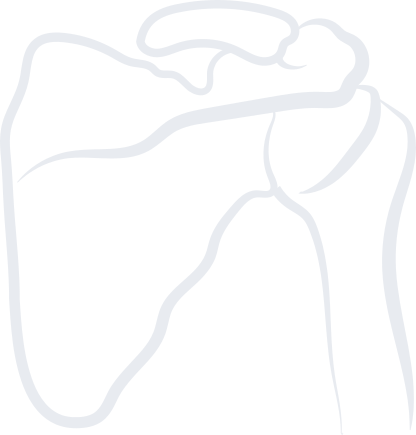
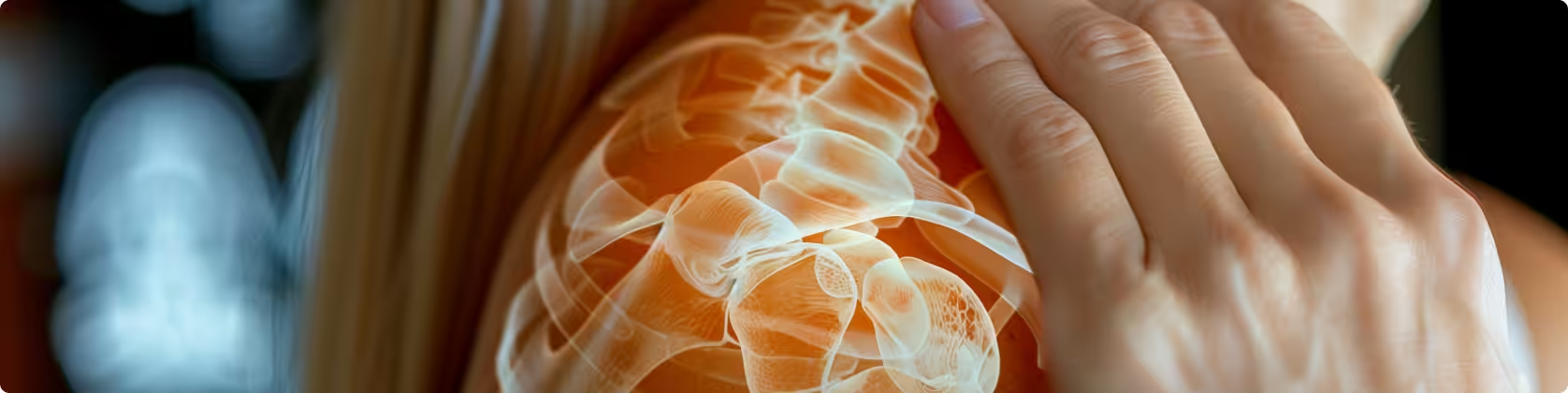
Shoulder instability following a traumatic event is one of the most common documented shoulder injuries. Its incidence is particularly high among military personnel and in contact sports such as martial arts, football, and basketball. Patients with epilepsy are also more prone to dislocation during seizures. This type of injury carries a strong tendency to recur, which is directly related to the age at the time of the first dislocation. For instance, a patient younger than 20 years old at the time of the first dislocation has about a 90% chance of sustaining another dislocation within the following years. The most common direction of shoulder dislocation is anterior, although less frequent variations exist, such as posterior dislocation or multidirectional shoulder instability. This chapter focuses primarily on traumatic anterior shoulder dislocation.
The shoulder joint is extremely mobile and, as a result, inherently unstable. Its stability, however, is ensured by various static and dynamic stabilizers that resist uncontrolled movement. The static stabilizers include the congruence of the articular surfaces of the humerus and scapula, the surrounding joint capsule, the glenohumeral ligaments acting as restraints against specific directions of movement, and the labrum, a fibrocartilaginous structure that increases the effective depth of the glenoid cavity by about 50%. The dynamic stabilizers include the rotator cuff muscles and interval, the periscapular muscles, and the tendon of the long head of the biceps brachii.
The most common mechanism for anterior shoulder dislocation is the application of a forward-directed force on an abducted and externally rotated shoulder. During the dislocation of the humeral head from the glenoid cavity, several injuries may occur to both soft tissues and bony structures, the recognition of which is critical for diagnosis and management. These include Bankart lesions, humeral avulsion of the glenohumeral ligament (HAGL lesion), glenoid labral articular defects (GLAD lesions), anterior periosteal sleeve avulsion (ALPSA lesions), bony Bankart lesions, Hill-Sachs lesions, and fractures of the greater and lesser tuberosities (the insertion sites of the rotator cuff tendons). Additionally, rotator cuff tears may occur in association with a shoulder dislocation, with incidence increasing with age (approximately 30% in patients over 40 and up to 80% in those over 60). Nerve injuries can also accompany shoulder dislocations, most commonly transient axillary nerve neuropraxia, which presents as numbness over the deltoid region. Furthermore, patients with shoulder instability should also be evaluated for generalized joint hyperlaxity, as this may significantly influence treatment planning.
Patients experiencing a first-time dislocation usually present after a distinct traumatic event. However, as the number of dislocations increases, or in the presence of generalized ligamentous laxity, the force required to cause a dislocation decreases dramatically. In some cases, even a trivial movement, such as reaching for a bag in the back seat of a car, may be enough to cause dislocation. Some patients are even capable of voluntarily subluxating their shoulders. Apart from the dislocations themselves, the most common symptoms of shoulder instability include a subjective sense of joint instability and shoulder pain. Clinical examination by an orthopedic surgeon consists of various specific tests and maneuvers that highlight shoulder instability.
Imaging begins with plain radiographs and is almost always followed by MRI, which provides greater detail of both soft tissue and bony injuries. To further increase diagnostic accuracy for soft tissue lesions, contrast-enhanced MR arthrography may be performed.
Stop living in pain, improve the quality of your life!
Acute shoulder dislocations should be urgently reduced by appropriately trained healthcare professionals, either on site or in the emergency department, although spontaneous reduction is not uncommon. This is followed by a short period of immobilization in a sling (one to two weeks for simple dislocations), after which physiotherapy begins with the goal of strengthening the rotator cuff and periscapular muscles. Return to sport or daily activities is typically expected after one to three weeks. However, it is crucial to assess the risk of recurrence, which is unacceptably high in patients younger than 20 years, males, contact athletes, patients with hyperlaxity, and cases where glenoid bone loss exceeds 20–25% or when associated with a greater tuberosity fracture. Each dislocation is estimated to remove about 7% of the anteroinferior glenoid rim, leading to progressively increasing shoulder instability. The critical threshold of glenoid bone loss requiring surgical bone-block procedures is generally considered 20–25%, although many shoulder specialists argue that even subcritical bone loss of around 13.5% may result in unacceptably high recurrence rates.
Thus, surgical management of shoulder instability is often necessary. This includes both arthroscopic and open procedures, aimed at restoring the integrity, continuity, and tension of the stabilizing soft tissues or reconstructing the bony architecture of the glenoid when critical bone loss has occurred. For patients younger than 25 after a first dislocation, high-demand athletes, and those with recurrent shoulder instability and less than 20–25% glenoid bone loss, arthroscopic Bankart repair is the recommended surgical option. In cases of failed prior arthroscopic repair, associated bony Bankart lesions, hyperlax patients, or HAGL lesions—provided glenoid bone loss ranges between 20–25% (or even as low as 13.5% in select cases)—open Bankart repair may be the more appropriate choice.
When glenoid bone loss exceeds 20–25%, bone augmentation procedures are indicated to restore both anatomy and stability. These include the Latarjet–Bristow procedure, in which the coracoid process and its tendon attachments are transferred and fixed with screws to the anterior glenoid rim, or the use of tricortical bone grafts harvested from the patient’s pelvis or a cadaver donor.
Additional techniques in both open and arthroscopic surgery include the remplissage procedure, where soft tissue is used to fill a large Hill-Sachs lesion, or bone grafting for even larger defects. Tendon transfers may also be considered in cases with simultaneous irreparable rotator cuff tears.
In summary, shoulder instability encompasses a variety of injury patterns that may involve both soft tissue and bony structures, significantly influencing the likelihood of recurrence. Acute dislocations always require urgent reduction, followed by a short period of immobilization and physiotherapy. However, younger, more active patients, professional athletes (particularly in contact sports), and those with recurrent shoulder instability often require surgical treatment to achieve optimal functional outcomes and return to activity.
to guide you about your condition, so you can choose the best possible treatment for it.
We use cookies to improve your experience on our site. By using our site, you consent to cookies.
Manage your cookie preferences below:
Essential cookies enable basic functions and are necessary for the proper function of the website.
These cookies are needed for adding comments on this website.
Google reCAPTCHA helps protect websites from spam and abuse by verifying user interactions through challenges.
Google Tag Manager simplifies the management of marketing tags on your website without code changes.
Marketing cookies are used to follow visitors to websites. The intention is to show ads that are relevant and engaging to the individual user.
Google Maps is a web mapping service providing satellite imagery, real-time navigation, and location-based information.
Service URL: policies.google.com (opens in a new window)