
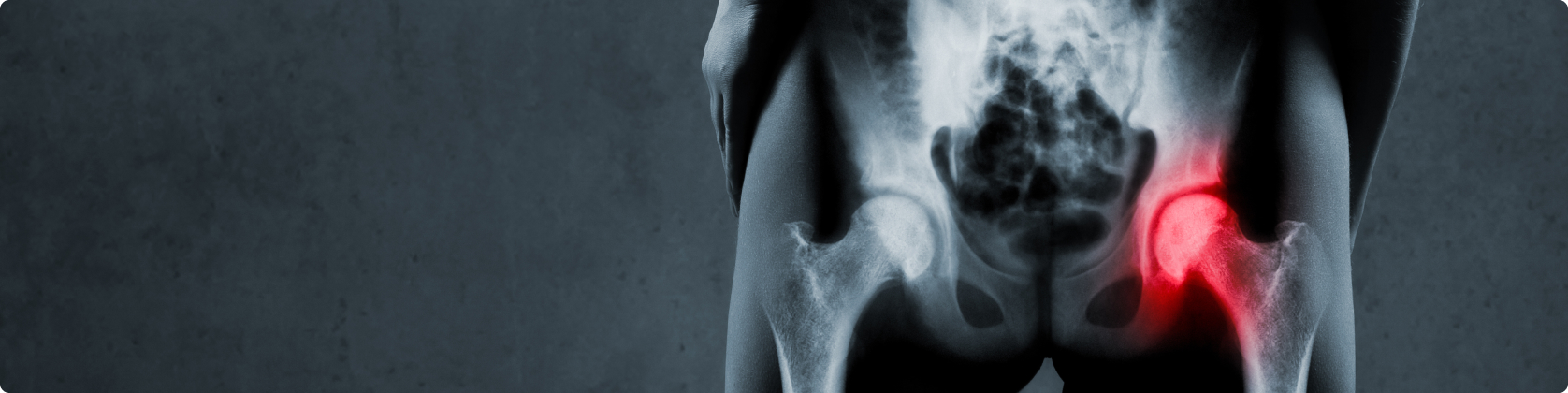
Total hip arthroplasty is one of the most commonly performed orthopaedic surgical procedures. The first attempts at replacing the arthritic joint surfaces of the hip date back to the early 1890s, although much progress has been made since then in terms of surgical approaches and technique, instruments, implants and biomaterials available etc. Modern total hip arthroplasty is based on the priciples of the “low friction arthroplasty” as described ansd first performed by Sir John Charnely in the 1960s. Nowadays, it is considered one of the most successful orthopaedic procedures in our armametnarium. The main indication for performing a total hip arthropalsty is end-stage arthritis of the hip joint. Its aetiology may either be uknown, i.e. primary arthritis, or secondary to a joint-destructing condition, such as intracapsular hip fractures (femoral neck fractures), certain femoral head or acetabular fractures, osteonecrosis – avascular necrosis of the hip, hip dysplasia, crystalline or rheumatic disease arthropathy, post-septic arthritis, neoplastic disorders etc.
There are two main categories of hip arthroplasty: total hip arthroplasty and hip hemiarthroplasty. Total hip arthroplasty consists of the replacement of the joint surfaces of both the acetabulum and the femoral head by their respective prostheses with the interference of a bearing surface (liner), which along with the prosthetic femoral head is deigned to offer optimal tribologic conditions for joint motion. The most commonly used type of total hip arthroplasty invovles a metal acetabular component with a plastic (polyethelene) or ceramic liner and a metal femoral stem with a metal or ceramic prosthetic head. Fixation of the components of the arthroplasty to bone is nowadays most commonly achieved through cementless, press-fit technique with the occasional need for screw augmentation of the prosthetic acetabulum. Fixation with the use of bone cement is also possible and preferred in certain cases, such as highly osteoporotic bone or post-radiotherapy. Other options for total hip arthroplasty involve the use of dual-mobility or even constrained liners.
Hip hemiarthropalsty, on the other hand, involves the implantation of a femoral component, either press-fit or cemented, with (most commonly) a bipolar prosthetic head, which is composed by a small (Φ 28mm) metallic head envelopped by a larger, metallic hemisphetrical cup working as a a single construct. The articular surface of the acetabulum is not replaced in this procedure, so that the prosthetic head articulates directly with the native acetabulum, its two components gliding in tandem within the latter.
Standard preoperative evaluation of a patient scheduled for total hip arthroplasty involves apart from history-taking and clinincal examination by the operating surgeon, standing ( if possible) anteroposterior radiographs of the pelvis and lateral radiographs of the opertive hip, though it is good practise to obtain radiographs of the ipsilateral femur, especially in cases of previous orthopaedic surgery more distally. Basic laboratory examinations, an electrocardiogram, a chest radiograph as well as peoperative evaluation by an anesthetist and, if needed by a cardiologist or other specialties, are also included in this phase. Moreover, the operating surgical team will evaluate the preoperative radiographs and perform a templating of the implants which are to be used in order to calculate their size and orientation, the preoperative leg length discrepancy and hoew this will be restored after the impantation of the artrhoplasty componets and other technical details. Prior to the sugery, the patient will also be informed on the possibility of intra- or post- operative need for blood transfusion and they will be required to read and sign with the aid of the operating team an informed consent form.
During the operation the patient will be on the operating table either in the supine or the lateral decubitus position based on the approach to the hip joint utilised. The surgical field is sterilised in order to cover a wide area around it, including the abdomen up to the umbilicus and the operating or both legs down to the ankle. After proper sterile draping of the field, an incision to the skin is made, its location depending on the approach to the hip favoured by the operating surgeon. Dependent upon the approach are also the soft tissues (muscles, tendons, parts of the joint capsule etc.) which will have to be detached in order to reach the hip joint. Once there, the surgical steps are the same regardless of the approach. The femoral neck is osteotomised with a saw at the predetermined level and the femoral head removed. The acetabulum is then prepared with the use of hemispherical reamers to the best fitting size and a trial component is inserted to determine its stability. If it is stable and well seated within the acetabulum, the final implant is inserted press-fit with a trial liner inside it. Attention is then shifted to the femur, whose medullary canal is opend and dilated with special chisel and reamers in order to accomodate the smaller size rasp available. WIth the use of rasps of increasing size the femur is prepared to the point where the rasp properly fills its most proximal part and is rotationally stable. Using a trial neck and head, the hip is reduced and evaluated for range of motion, stability, possible impingement and leg length discrepancy. Radiographic evaluation of the prosthetic joint is also advisable at this time during the surgery. When all of the above requirements are met, the joint is redislocated and the final components are impanted: the liner, the femoral stem and the prosthetic head. After the final joint reduction, the wound is irrigated and injected with local anaesthetic and tranexamic acid to control postoperative pain and bleeding, respectively. Finally, the wound is closed with sutures in a layered fashion making sure to restore the continuity of all the anatomic structures incised during the approach.
During the immediate (in-hospital) postoperative period after an uneventful total hip arthroplasty, the patient begins partial to full weight-bearing with the assistance of a walker or two crutches. Gradual compression stockings and oral or subcutaneous anticoagulation are used for 40 days postoperatively, while antibiotics are also given perioperatively. Pain control is achieved through intravenous, at first, and then, once the patient returns home, oral analgesics mianly including paracetamol and some mild opioid (e.g. codeine or tramadol), as wel as an anti-inflammatory.
Depending on the surgeon’s specific protocol, patients may or may not be routinely prescribed physical therapy after the operation. If so, it would involve teaching the patient to walk using the walker or crutches in and out of the house, to use staircases, to get in an out of their car accompanied by gradual kinesiotherapy and strengthening exercises involving the torso, the hip and knee. Furthrmore, it is imperative that the patient understands and adheres to the restrictions given during the first four to six postoperative weeks in order to avoid hip dislocation. These invariably include hip flexion greater than 90° in any position (standing, lying in bed, seated etc.) and, depending on the surgical approach utilised during the operation, adduction and internal rotation (e.g. in-toeing when sitting or squatting, lying on the side in bed without a pillow between the thighs) for posterior approaches and abduction and external rotation (e.g. seating cross legged) for lateral and anterolateral approaches. Finally, return to full, unassisted weight-bearing and driving is expected at four to six weeks postoperatively, at which time a postoperative visit is scheduled. The majority of patients having had a total hip arthroplasty for arthritis are expected to “forget” having had hip surgery in the long term, while return to most low-impact sports is considered safe.
In conclusion, hip arthroplasty is nowadays a routine orthopaedic procedure which has succeded in alleviating the symptoms of thousands of patients with hip arhtritis and other conditions. Though it can be performed through various approaches, its rationale remains the same, while studies have also shown equally postiive long-term outcomes regardless of the approach used. Modern postoperative protocols emphasise on immediate, at least partial weight-bearing after surgery and accelarated return to activities of daily living, work and sport.
to guide you about your condition, to choose the best possible treatment.
We use cookies to improve your experience on our site. By using our site, you consent to cookies.
Manage your cookie preferences below:
Essential cookies enable basic functions and are necessary for the proper function of the website.
These cookies are needed for adding comments on this website.
Google reCAPTCHA helps protect websites from spam and abuse by verifying user interactions through challenges.
Google Tag Manager simplifies the management of marketing tags on your website without code changes.
Marketing cookies are used to follow visitors to websites. The intention is to show ads that are relevant and engaging to the individual user.
Google Maps is a web mapping service providing satellite imagery, real-time navigation, and location-based information.
Service URL: policies.google.com (ανοίγει σε νέο παράθυρο)


