
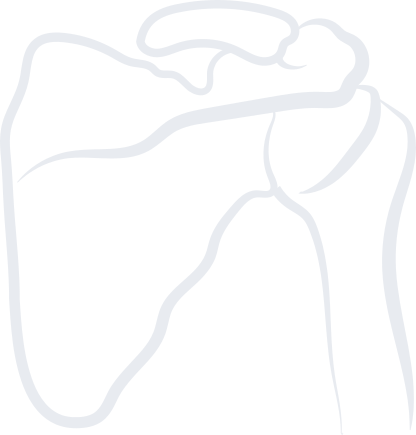

Arthroscopy of the shoulder joint is a minimally invasive surgical technique which can be utilized to diagnose and treat a variety of shoulder pathologies. Also known as “keyhole surgery”, it involves the insertion of specialized instruments through small skin incisions to perform, with the ongoing development of new surgical techniques and the advent of newer technologies and materials, some of the most complex operations in the shoulder joint. Although the surgery is usually performed under general anesthesia with the occasional addition of a regional nerve block for postoperative pain control, in patients where surgery is strongly indicated but may not be fit for general anesthesia, regional nerve blocks (supraclavicular or inter-scalene block) can be used safely as the only method of anesthesia throughout the procedure. During the surgery, the patient is placed either in the reclined, seated, “beach-chair” position or lying on the side in the lateral decubitus position. Both have their advantages and disadvantages, the former being more versatile should a transition to open surgery be deemed necessary during the procedure and allowing for less bleeding at the surgical site, the lateral possibly allowing for better visualization within the joint due to traction applied to the arm. Eventually, this is a matter of surgeon preference and ease with each position.
Arthroscopic surgery is universally performed through small (0,5-1cm) incisions, through which specially designed instruments are inserted within the different joint compartments allowing for visualization (camera and lighting), closed circuit water inflow and outflow, retraction, cutting, cauterization, drilling, suturing etc. In most shoulder surgery cases two to three arthroscopic portals are utilized for joint access: one posterior, one anterior, one lateral and/or one additional, secondary portal. The skin is closed with one or two sutures per portal and a large, soft dressing is applied as well as a sling or shoulder immobilizer depending on the specific postoperative restrictions of the surgery performed.
As far as its clinical applications, shoulder arthroscopy can be a powerful diagnostic tool allowing the surgeon to readily assess the whole of the shoulder joint as well as the subacromial space (where the tendons of the rotator cuff muscles can be found) and the acromio-clavicular (AC) joint, shedding light to diagnostic dilemmas which cannot be solved by the different imaging modalities available. Moreover, arthroscopy can be used to remove intra-articular loose bodies, to repair injuries to the labrum and the long head of the biceps tendon as seen in shoulder instability and SLAP (Superior Labrum Anterior to Posterior) lesion, respectively. It can also be used to debride and repair tears of the rotator cuff tendons along with subacromial decompression. Pathology of the AC joint can also be arthroscopically addressed be it for traumatic instability (coraco-clavicular ligament reconstruction) or for degenerative disease (e.g. distal clavicle resection). Through an arthroscopic approach it is also possible to release contractures of the joint capsule seen in frozen shoulder/adhesive capsulitis, should mobilization of the joint under anesthesia prove to be ineffective in improving range of motion. In shoulder arthritis arthroscopy can provide a minimally invasive initial procedure to remove osteophytes, loose bodies and hypertrophic synovium freeing shoulder motion to some degree and “buying time” until a more invasive procedure, such as arthroplasty, has to be performed. Finally, tenotomy or tenodesis procedures of the long head of the biceps tendon can be addressed arthroscopically, as can the more uncommon suprascapular nerve entrapment.
Although shoulder arthroscopy is generally safe, it cannot be free of any risk of complications, as is the case with every surgical procedure. Infection rates are low (less than 1%), and so are intra-operative fractures, or injuries to tendons and the joint cartilage. Failure of arthroscopic labral or rotator cuff repair is a known complication, which surgeons strive to avoid by meticulously selecting who is best indicated for an arthroscopic procedure versus who would benefit more from open surgery. Despite their size, the creation of the arthroscopic portals and the insertion of instruments through them can potentially endanger nearby nerves and vessels. However, the frequency of such injuries is generally low and the symptoms most of the time are only temporary, taking the form of neurapraxias. More specifically, posterior portal placement can lead to injury of the axillary (shoulder numbness, weakness in shoulder abduction) or the suprascapular (weakness in shoulder abduction and external rotation) nerve, while anterior portal placement can damage the cephalic vein (postoperative hematoma to the arm and chest) or the musculocutaneous nerve (numbness over lateral half of forearm, weakness in forearm supination and elbow flexion). Finally, the use of an interscalene block for anesthesia or postoperative analgesia could potentially injure the phrenic nerve leading to ipsilateral hemidiaphragm paresis and, thus, strained breathing. Nevertheless, all of the aforementioned neurovascular complications can be prevented with the use of anatomic landmarks for precise portal creation, as well as the use of nerve stimulation or ultrasound guidance by the anesthetist when performing a regional nerve block.
Postoperative rehabilitation protocols after arthroscopic shoulder surgery can vary based on the specifics of each procedure. As a general rule, all patients are placed in some form of shoulder immobilization after the operation, while sutures are removed two weeks postoperatively. Patients having undergone rotator cuff debridement, release of joint contractures, osteophytes or loose bodies or even synovectomy can begin active and active-assisted shoulder motion almost immediately after the operation. On the other hand, after rotator cuff or labral repairs, tendon transfers or bone block procedures the shoulder must remain immobilized in a special orthosis for four to six weeks before active or active-assisted shoulder motion is begun. During this period, gentle scapula mobilization is permitted to reduce stiffness and pain from immobilization. Passive shoulder mobilization as well as strengthening exercises are progressively added after the initial six-to-eight-week postoperative period. Full return of strength and function, especially in elite athletes and heavy manual laborers, can be take up to six months.
To summarize, arthroscopy of the shoulder is a versatile, minimally invasive surgical technique which can be used to treat a large variety of shoulder conditions. With the use of specialized instrumentation, complex surgeries can be performed through small incisions allowing for minimal surgical trauma and, thus, reduced postoperative pain. Although not free of complications, these are generally uncommon and mild in nature. Postoperative rehabilitation, despite the relatively atraumatic nature of this surgical approach, can be prolonged, reaching up to six months, owing to the healing potential of the repaired/reconstructed soft tissues as well as the complexity of the shoulder region as an anatomic entity and the time needed for it to return to full function.
to guide you about your condition, to choose the best possible treatment.
We use cookies to improve your experience on our site. By using our site, you consent to cookies.
Manage your cookie preferences below:
Essential cookies enable basic functions and are necessary for the proper function of the website.
These cookies are needed for adding comments on this website.
Google reCAPTCHA helps protect websites from spam and abuse by verifying user interactions through challenges.
Google Tag Manager simplifies the management of marketing tags on your website without code changes.
Marketing cookies are used to follow visitors to websites. The intention is to show ads that are relevant and engaging to the individual user.
Google Maps is a web mapping service providing satellite imagery, real-time navigation, and location-based information.
Service URL: policies.google.com (ανοίγει σε νέο παράθυρο)


