
Surgical technique
Knee Arthroscopy
Knee arthroscopy is a minimally invasive surgical technique that allows the Orthopedic Surgeon to examine and repair damage inside the knee joint through small incisions and with the help of a special camera. It is one of the most common orthopedic operations worldwide, with excellent results and rapid recovery.
Dr. Ioannis Tsarouhas, Orthopedic Surgeon specialising in arthroscopic surgery of the major joints and in sports injuries, treats a wide range of knee conditions arthroscopically, with the aim of returning the patient to their activities as quickly as possible.
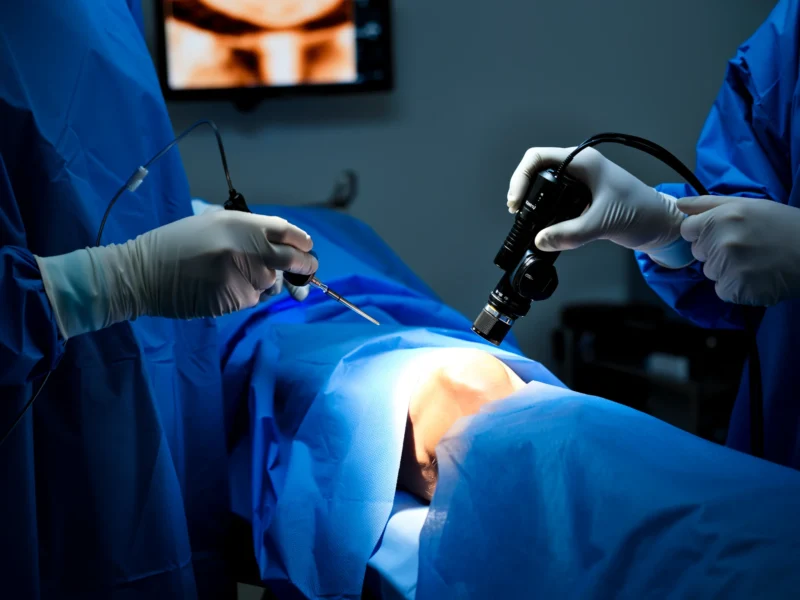
What is knee arthroscopy?
Arthroscopy is a technique in which the surgeon introduces into the joint a thin instrument with a miniature camera and light source —the arthroscope— which transmits a high-resolution image to a screen. Through one or two additional small incisions, the surgeon introduces specialised instruments to repair the damage.
The major advantage of the method is that it allows both diagnosis (direct visual inspection of the structures of the joint) and treatment in the same sitting, without the need for a large open incision. This minimises trauma to healthy tissue, reduces pain and speeds up recovery.
Anatomy of the knee
The knee is the largest joint in the human body and one of the most complex. It is formed by three bones —the femur, the tibia and the patella— whose surfaces are covered by articular cartilage, a smooth tissue that allows pain-free movement.
Inside the joint lie structures that are crucial to its function: the two menisci (medial and lateral), which act as shock absorbers and stabilisers; the cruciate ligaments (anterior and posterior), which control sliding and rotation; and the synovial membrane, which produces the lubricating fluid. Arthroscopy allows all of these structures to be inspected directly and their lesions to be repaired — something that imaging alone cannot always replace.
When is knee arthroscopy indicated?
Knee arthroscopy is used to treat a wide range of conditions, such as:
- Meniscus tear: one of the most common indications. Depending on the type and location of the tear, the meniscus is repaired with sutures or, where this is not feasible, a limited removal of the damaged part is carried out (partial meniscectomy).
- Tear of the anterior (or posterior) cruciate ligament: the reconstruction is performed arthroscopically, using a graft.
- Cartilage lesions: repair or smoothing of worn areas of the articular cartilage, with techniques such as microfracture.
- Loose bodies: removal of fragments of cartilage or bone that “lock” the joint.
- Synovitis: removal of inflamed synovial membrane.
- Conditions of the patella and certain cases of early arthritis with mechanical symptoms.
The indication for arthroscopy is always established after clinical examination and imaging (mainly MRI), and provided the symptoms justify surgical intervention.
Diagnostic and therapeutic role
One of the key features of arthroscopy is its dual role. On the one hand, it acts as a highly accurate diagnostic tool: although MRI is excellent at demonstrating lesions, direct visual inspection of the joint provides information that no imaging study can give with the same certainty — for example, the exact extent and stability of a cartilage lesion or a meniscus tear.
On the other hand, in the same sitting, arthroscopy becomes therapeutic: as soon as the lesion is identified, the surgeon proceeds to repair it. This combination of diagnosis and treatment in a single operation is one of the most important advantages of the method, as it avoids the need for a second procedure.
When arthroscopy is NOT indicated
It is equally important to stress when arthroscopy is not the appropriate solution. In patients with advanced knee osteoarthritis —where cartilage wear is extensive and diffuse— arthroscopy offers no lasting benefit and is not a substitute for knee replacement.
Modern orthopedic practice has abandoned the use of arthroscopy as a “clean-out” in advanced arthritis, as the benefits are limited and temporary. Arthroscopy retains its value in specific conditions with mechanical symptoms —such as a meniscus tear or a loose body— and not as a general solution for every painful knee. The role of the specialist surgeon is precisely to recognise which patient will truly benefit.
How the procedure is performed
Knee arthroscopy is performed under general, spinal or, in some cases, local anaesthesia. The surgeon makes two or three small incisions (of a few millimetres) around the knee. The arthroscope is introduced through one of them and the surgical instruments through the others.
The joint is gently distended with sterile fluid to create space and a clear field of view. The surgeon inspects all the structures in detail —menisci, cruciate ligaments, articular cartilage, synovial membrane— and proceeds to repair the damage. The duration of the operation depends on the nature and complexity of the problem.
In most cases, knee arthroscopy is performed as a day-case procedure, with the patient returning home the same or the following day.
Cartilage lesions and their arthroscopic treatment
Lesions of the articular cartilage form a distinct category of conditions that are treated arthroscopically. Articular cartilage, unlike other tissues, has a limited capacity to heal itself, as it has no blood supply of its own. For this reason, cartilage lesions —whether traumatic or degenerative in origin— require specialised treatment.
Depending on the extent, depth and location of the lesion, the surgeon may choose different techniques: from simple smoothing of the worn area to techniques that stimulate the growth of new tissue (such as microfracture, which creates small channels in the underlying bone so that repair cells are attracted). The choice of the appropriate technique is individualised and depends on the characteristics of the lesion and the needs of the patient.
Before the operation
Preparation includes the necessary pre-operative laboratory tests, cardiological and anaesthetic assessment, as well as imaging (mainly MRI), which “maps” the lesions and guides the planning of the operation. The patient is informed about the procedure and about the individualised rehabilitation plan, which depends directly on the type of intervention to be performed.
Post-operative course and rehabilitation
Recovery after knee arthroscopy is as a rule rapid, but it depends to a large extent on the type of intervention. A simple debridement or a partial meniscectomy allows a very quick return, whereas a meniscal repair or a cruciate ligament reconstruction requires a longer and more careful programme.
In general, mobilisation starts immediately, often with the help of a crutch for a short period. The physiotherapy programme focuses on reducing swelling, regaining range of motion, strengthening the muscles (especially the quadriceps) and, gradually, restoring proprioception and sporting movements. Faithful adherence to the programme is decisive for an excellent result and a safe return to activity.
Meniscus tear: the most common indication
A meniscus tear is the most common reason for knee arthroscopy and deserves special mention. The menisci are two crescent-shaped structures of fibrocartilage that act as “shock absorbers” between the femur and the tibia, distributing loads and stabilising the joint.
The tear may be traumatic (often in younger people, after a twisting injury) or degenerative (at older ages, as a result of wear). Arthroscopic treatment is individualised: wherever feasible —especially in younger patients and in tears in the vascularised periphery of the meniscus— repair with sutures, which preserves the meniscus, is preferred. When repair is not feasible, a limited partial meniscectomy is performed, removing only the damaged part and preserving as much healthy tissue as possible.
The trend in modern surgery is clearly in favour of preserving the meniscus whenever possible, as its extensive removal is associated with an increased risk of early arthritis.
Rehabilitation according to the condition
Because arthroscopy covers a wide range of conditions, rehabilitation differs considerably according to the intervention performed:
- Partial meniscectomy: rapid recovery, with return to everyday activities within a few weeks.
- Meniscal repair: more careful and prolonged rehabilitation, with protection of the repair for several weeks so that the meniscus can heal.
- Cruciate ligament reconstruction: a longer programme, with gradual return to sport in 4-9 months.
- Cartilage repair: the programme is adapted to the type of technique and often requires protected weight-bearing.
The surgeon defines the individualised programme and the progress milestones, which the patient must follow faithfully for a safe and excellent result.
Advantages of arthroscopy
Knee arthroscopy offers significant advantages over open surgery:
- Minimal trauma to healthy tissue and small, discreet scars
- Less post-operative pain
- Faster recovery and return to everyday life
- The possibility of discharge on the same day
- Low complication rate
Complications are rare and include, as with any operation, a small risk of infection, thrombosis or transient swelling — risks that are minimised by meticulous technique and proper rehabilitation.
Historical development and significance of the method
Arthroscopy revolutionised orthopedic surgery. Before it became established, the treatment of many intra-articular conditions of the knee required extensive open surgery, with large incisions, significant tissue trauma, a prolonged hospital stay and a long recovery.
The development of arthroscopic technology —with miniature optical systems and specialised instruments— made it possible to treat the same conditions through incisions of a few millimetres. Today, knee arthroscopy is one of the most common and most established orthopedic operations worldwide, with documented safety and effectiveness. The continuous evolution of techniques —especially in the direction of tissue preservation, such as repair rather than removal of the meniscus— is constantly improving long-term results.
Cost of knee arthroscopy
The cost of knee arthroscopy differs from patient to patient, as it depends on the type and complexity of the intervention (simple debridement, meniscectomy, meniscal repair, ligament reconstruction), the materials that may be used, the hospital and room category, as well as the patient’s insurance cover.
In most cases, private insurance policies and insurance funds cover a significant part of the expense. Precise information is provided on an individual basis, after the clinical assessment. The practice is at your disposal for any relevant information.
More on the factors that determine the cost and on cover by insurance funds: Cost of surgery.
Frequently asked questions
Is knee arthroscopy painful?
Post-operative pain is as a rule mild, thanks to the minimally invasive nature of the method, and is controlled effectively with painkillers. It subsides gradually over the first few days.
How long does the operation take?
The duration depends on the type of intervention. A simple debridement or a meniscectomy takes less time, while a meniscal repair or ligament reconstruction takes longer. In most cases it is a day-case procedure.
When will I walk after arthroscopy?
Mobilisation starts immediately, often with the help of a crutch for a short period. The exact time to full weight-bearing depends on the type of intervention.
When will I return to sport?
It depends on the condition treated: from a few weeks after a simple intervention to several months after cruciate ligament reconstruction. The return is gradual, based on safety criteria.
Will I need physiotherapy?
Yes, physiotherapy is an important part of rehabilitation, focusing on reducing swelling, regaining range of motion and strengthening the muscles. The programme is individualised according to the intervention.
Is the cost covered by insurance?
In most cases, private insurance policies and insurance funds cover part or all of the expense. The practice can give you detailed information.
Does arthroscopy leave scars?
The incisions are very small, of the order of a few millimetres, and leave discreet, almost invisible scars — one of the cosmetic advantages of the method over open surgery.
Can arthritis be treated with arthroscopy?
In advanced osteoarthritis, arthroscopy offers no lasting benefit and is not a substitute for knee replacement. It retains its value in specific conditions with mechanical symptoms, such as a meniscus tear or loose bodies.
Contact
Book an appointment with Dr. Tsarouhas
Fill in the form with the time that suits you and we will contact you, or call us directly.
Call us 210 6464 744-
Petroupoli 1 Agias Triados St., 132 31 210 5011 717
-
Heraklion, Crete 49 Kyrillou Loukareos St., 712 01
Appointment request
We reply to every request on the same or the next working day.
Your details are used solely to contact you.