
Orthopedic condition
Hip Osteoarthritis
Hip osteoarthritis is one of the commonest causes of chronic pain and stiffness in the hip and groin, particularly in older people. It is a degenerative disease that progressively affects the articular cartilage, severely limiting mobility and quality of life.
Dr. Ioannis Tsarouhas, Orthopedic Surgeon with particular expertise in hip osteoarthritis and the ASI method, treats the condition across the full range of its stages, from conservative management to modern, minimally invasive hip replacement.
Definition
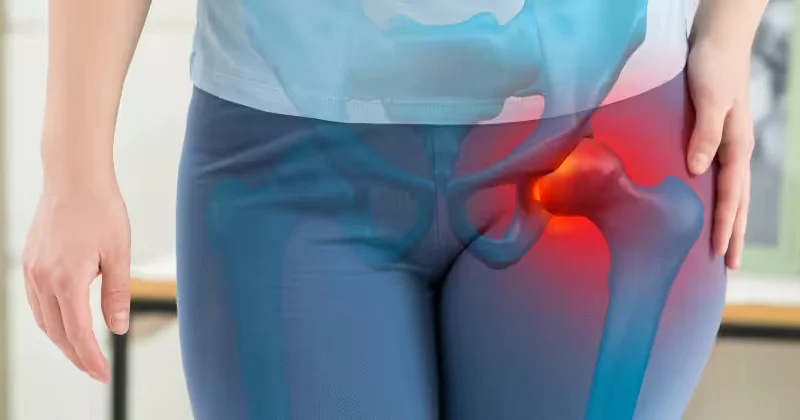
The hip joint is one of the largest and most important joints in the human body, as it connects the trunk to the lower limb. It consists of the acetabulum (the articular surface in the pelvis), the head of the femur and the soft tissues that surround it (synovial membrane, joint capsule, ligaments). The articulating surfaces of the acetabulum and the femoral head are lined with articular cartilage, a special tissue, smooth and resilient, which ensures smooth movement with minimal friction.
Osteoarthritis of the hip is a chronic, degenerative condition of the joint, characterised by the progressive wear and loss of the articular cartilage that covers the femoral head and the acetabulum. This cartilage is a smooth, resilient tissue that allows smooth, painless movement of the joint and absorbs shock.
As the cartilage wears away, the bones gradually begin to rub against each other, causing pain, inflammation, stiffness and progressive restriction of movement. At the same time, osteophytes develop (new bone at the margins of the joint) and the joint capsule contracts, limiting mobility even further.
Causes and risk factors
Many factors, often acting in combination, contribute to the development of hip osteoarthritis:
- Age: Over the years, cartilage wears naturally.
- Genetic predisposition: Family history plays an important role.
- Excess body weight: It places a chronic load on the joint.
- Pre-existing hip conditions: Dysplasia, femoroacetabular impingement, avascular necrosis or old fractures lead to secondary arthritis.
- Previous injuries to the area.
- Inflammatory diseases, such as rheumatoid arthritis.
- Heavy strain, occupational or athletic.
Clinical picture – Symptoms
The symptoms of hip osteoarthritis set in gradually and worsen over time:
- Pain, typically felt in the groin, which may radiate to the thigh or the knee. It worsens with weight-bearing and activity.
- Stiffness, particularly in the morning or after a period of inactivity.
- Restricted range of motion: difficulty with movements such as putting on socks or shoes, or getting into the car.
- A limp when walking.
- A grating sensation (crepitus) in the joint.
In advanced stages, pain may occur even at rest or at night, disturbing sleep.
Stages of osteoarthritis
Hip osteoarthritis progresses gradually. In the early stages, cartilage wear is mild and the symptoms are intermittent, appearing mainly after strenuous activity. In the intermediate stages, pain becomes more frequent and constant, stiffness more pronounced and the restriction of movement evident in everyday life. In the final stages, the cartilage has been almost completely destroyed (a “bone-on-bone” condition), pain is constant and function is severely limited.
The stage of the disease largely determines the treatment approach.
Diagnostic methods
The diagnosis of hip osteoarthritis is based on the history, the clinical examination and imaging. The orthopedic surgeon assesses the character and location of the pain, as well as the range of motion of the joint.
Radiographs (X-rays) are the mainstay of diagnosis: they show narrowing of the joint space (a sign of cartilage wear), osteophytes and the other arthritic changes. MRI is used in selected cases, particularly to reveal early lesions or to investigate associated conditions, such as avascular necrosis.
Treatment
The management of hip osteoarthritis is stepwise and is tailored to the stage, the severity of the symptoms, and the age and needs of the patient.
Early / conservative stage
In the early stages, treatment is conservative and includes:
- Activity modification and avoidance of whatever aggravates the pain.
- Weight loss, where needed.
- Physiotherapy to strengthen the muscles that stabilise the hip and to maintain range of motion.
- Medication (analgesics, anti-inflammatories) to control pain.
- Walking aids (e.g. a walking stick) in selected cases.
Final / surgical stage
When the arthritis is advanced and the symptoms do not respond to conservative treatment, the indicated solution is total hip replacement. Dr. Tsarouhas uses the modern, minimally invasive ASI method (Anterior Supine Intermuscular), which — by passing between the muscles without cutting them — offers faster recovery, less pain and a lower risk of dislocation. Hip replacement is one of the most successful operations, providing substantial and lasting relief.
Before and after treatment
Before treatment, a patient with advanced osteoarthritis lives with chronic groin pain, stiffness and severe restriction of movement, with everyday life defined by the limits the joint imposes. After hip replacement with the ASI method and completion of rehabilitation, most patients regain pain-free movement and return to activities they had given up.
The role of physiotherapy
Physiotherapy is one of the cornerstones of the conservative management of hip osteoarthritis, as well as of rehabilitation after hip replacement. A well-designed programme focuses on strengthening the muscles that stabilise and unload the hip — particularly the abductors and the gluteal muscles — on maintaining and improving range of motion, and on correcting gait.
Regular, supervised exercise not only relieves symptoms but can also slow the progression of the disease and postpone the need for surgery. It is important that the exercises are tailored to the individual and performed correctly, which is why working with a specialised physiotherapist, under the guidance of the orthopedic surgeon, is of real value.
How it affects everyday life
In its advanced stages, hip osteoarthritis profoundly affects quality of life and independence. Activities that are taken for granted gradually become difficult: walking any distance, climbing stairs, putting on socks and shoes, getting into the car, even sleeping when the pain occurs at night.
It is this progressive limitation — even more than the pain itself — that drives most patients to seek a definitive solution. Hip replacement with the ASI method, precisely because it allows a rapid return to mobility, has significantly changed the experience of these patients, allowing them to regain their independence quickly.
Prevention
Although osteoarthritis cannot always be prevented, certain measures reduce the risk or slow its progression: maintaining a healthy body weight, regular low-impact exercise, strengthening the hip muscles, avoiding excessive strain and the timely treatment of pre-existing conditions (such as dysplasia).
Secondary arthritis: when there is an underlying cause
A significant proportion of cases of hip osteoarthritis — particularly in younger patients — are “secondary”, meaning that they are due to an underlying condition that disturbed the normal mechanics of the joint. The commonest such causes are hip dysplasia, femoroacetabular impingement, avascular necrosis of the femoral head and old fractures.
Recognising such an underlying cause matters, because in some cases — when it is diagnosed early, before the wear progresses — it can be treated with joint-preserving surgery, delaying or preventing the need for hip replacement. For this reason, hip pain in younger patients deserves specialist investigation.
Cost of treatment
The cost depends on the type of treatment (conservative or surgical) and, in the case of surgery, on the implant materials, the hospital and the class of room, as well as the patient’s insurance cover. In most cases of hip replacement, private insurance policies and insurance funds cover a significant part of the expense.
Precise information is given on an individual basis, after the clinical assessment. The practice is at your disposal for any relevant information.
More on the factors that determine the cost and on cover by insurance funds: Cost of surgery.
When to see an orthopedic surgeon
Hip osteoarthritis is easier to manage the earlier it is diagnosed. You should seek a specialist orthopedic assessment if you notice persistent pain in the groin or hip, stiffness (particularly in the morning), progressive difficulty walking or climbing stairs, difficulty with everyday movements (putting on socks or shoes, getting into the car), or the onset of a limp.
Early diagnosis allows appropriate treatment to begin at a stage when conservative methods are most effective, delaying or preventing the need for surgery.
Frequently asked questions
Where is the pain felt in hip osteoarthritis?
The pain is typically felt in the groin and may radiate to the thigh or even the knee. It worsens with weight-bearing and walking.
Can hip osteoarthritis be cured?
Cartilage wear cannot be reversed, but the symptoms can be treated effectively. In the early stages this is done by conservative means, while in advanced stages hip replacement offers a definitive and lasting solution.
Do I definitely need surgery?
Not necessarily. In the early and intermediate stages, conservative treatment can provide significant relief. Hip replacement is indicated when the pain and limitation can no longer be controlled conservatively.
What is the ASI method?
It is a minimally invasive hip replacement technique, using an anterior approach with the patient lying supine, which passes between the muscles without cutting them, offering faster recovery and a lower risk of dislocation.
Does weight loss help?
Yes, significantly. Every extra kilo adds load to the joint when walking, so weight loss reduces symptoms and slows the progression of the disease.
When should I see an orthopedic surgeon?
If you have persistent pain in the groin or hip, stiffness or restricted movement that affects your everyday life, you should be assessed promptly by a specialist orthopedic surgeon.
Is the cost covered by insurance?
In most cases of hip replacement, private insurance policies and insurance funds cover part or all of the expense. The practice can give you detailed information.
What is the difference between hip arthritis and low back pain?
The pain of hip arthritis is typically felt in the groin, whereas pain arising from the lower back (low back pain, sciatica) is felt in the back and radiates down the back of the leg. However, because the two may coexist, an accurate diagnosis by a specialist is important.
Contact
Book an appointment with Dr. Tsarouhas
Fill in the form with the time that suits you and we will contact you, or call us directly.
Call us 210 6464 744-
Petroupoli 1 Agias Triados St., 132 31 210 5011 717
-
Heraklion, Crete 49 Kyrillou Loukareos St., 712 01
Appointment request
We reply to every request on the same or the next working day.
Your details are used solely to contact you.