
The painless and atraumatic solution to osteoarthritis
Minimally Invasive Hip Replacement (ASI)
Hip osteoarthritis is one of the most common and painful degenerative joint conditions, dramatically affecting the quality of life, mobility and psychological well-being of millions of people worldwide. When conservative treatment no longer provides relief, surgery becomes the only way forward.
Today, advances in medical technology and surgical techniques have radically changed the picture. ASI (Anterior Supine Intermuscular) Total Hip Replacement represents the cutting edge of orthopedic surgery, offering a minimally invasive, painless and completely atraumatic method. In this complete guide, we will cover everything about the ASI method, its advantages, how it compares with other techniques (such as AMIS and the conventional methods) and the role of the specialised Orthopedic Surgeon Dr. Ioannis Tsarouhas.
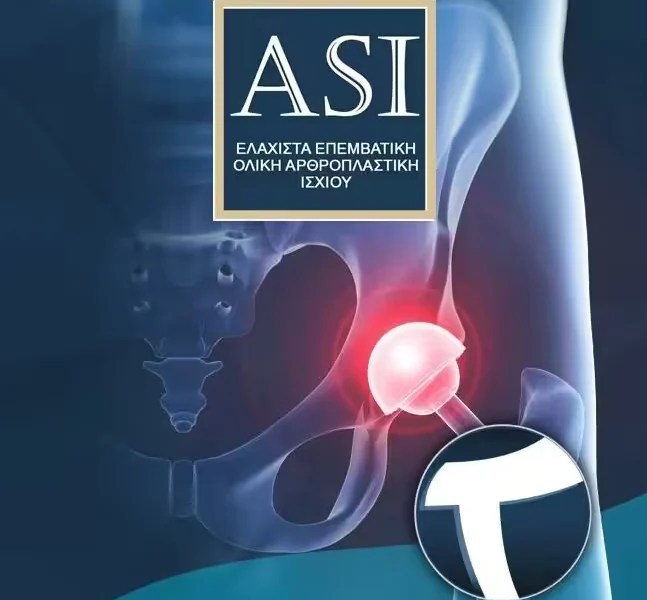
What is Hip Osteoarthritis?
Before going deeper into the treatment, it is important to understand the problem. The hip joint is one of the largest joints in the human body, designed to bear our weight and allow a wide range of movements. It consists of the head of the femur (the “ball”) and the acetabulum (the “socket” of the pelvis).
In osteoarthritis, the smooth cartilage that covers these surfaces and allows smooth, friction-free movement gradually wears away. The result? The bones rub against each other, causing severe pain, stiffness, restricted movement and, ultimately, serious disability. The ASI method restores this damage by replacing the destroyed surfaces with state-of-the-art implants, in the way that is kindest to the human body.
What is the ASI Method (Anterior Supine Intermuscular)?
The abbreviation ASI stands for Anterior Supine Intermuscular: an anterior approach, with the patient in the supine position (lying on the back), that passes between the muscles.
It is a minimally invasive technique (Minimally Invasive Surgery – MIS), performed through a very small skin incision (at the front of the hip). The distinguishing feature and the “key” to the success of the method is that the surgeon does not cut, detach or injure the muscles that surround and support the hip joint. Instead, the muscles are simply moved aside through their natural intervals (intermuscular) in order to reach the joint.
The Major Advantages of the ASI Method
Compared with the older, traditional surgical techniques, as well as with other modern methods, the ASI technique brings together an impressive number of advantages, radically changing the patient’s post-operative experience:
- No Cutting of Muscles or Tendons: The operation is performed without soft-tissue injury. The muscles and nerves remain completely intact.
- Minimal Blood Loss: Because no muscles or tissues are cut, bleeding is kept to a minimum. As a rule, the need for blood transfusion is avoided altogether, which reduces the risks of complications and infections.
- Remarkably Less Pain: Post-operative pain is directly linked to muscle injury. Without cutting muscles, the patient experiences minimal to no pain.
- Immediate Mobilisation: The most impressive feature of the ASI method is that the patient gets out of bed and walks as early as the first post-operative day (often just a few hours after surgery).
- Prevention of Muscle Atrophy: The prolonged bed rest required by the old methods led to muscle atrophy. With ASI, the immediate return to normal activities completely prevents this risk.
- Perfect Control of Leg Length (Equal Leg Length): The supine position (lying on the back) allows the surgeon to check the length of the leg with absolute accuracy during the operation. This rules out the risk of leg length discrepancy (a difference in the length of the two legs), a common problem with the conventional methods.
- Maximum Stability – Elimination of the Risk of Dislocation: Because the muscles (the “suspension system” of the hip) remain intact, the joint is extremely stable from the very first moment, eliminating the risk of dislocation.
- Use of Fluoroscopy: During the operation, real-time radiographic control is used, ensuring optimal, anatomical positioning of the arthroplasty components.
- Suitable for All Body Types: Even in cases of increased body weight or obesity, the technique is entirely suitable. The site of the anterior incision by its nature has minimal subcutaneous fat, which makes the operation easier.
- Shorter Operating Time: The total time required to complete the operation is significantly shorter than with the conventional methods, which also reduces the time spent under anaesthesia.
ASI Method vs. Conventional Methods
Conventional hip replacement techniques (e.g. the posterior or lateral approach) require large incisions (15-25 centimetres) and extensive detachment or division (cutting) of important muscle groups (such as the gluteal muscles) in order to expose the joint. This results in:
- Significant blood loss (frequent need for transfusions).
- Severe post-operative pain.
- Slow recovery that can last from weeks to months.
- Risk of dislocation, as the muscles that hold the joint in place have been weakened.
- Strict restrictions (e.g. no crossing the legs, no sitting on low chairs) for months.
ASI, as a modern approach, leaves these hardships in the past, making hip replacement a rapid-recovery (Fast Track) operation.
ASI versus AMIS: Why is ASI the Leading Choice?
Beyond the obvious advantages over conventional techniques, the ASI method also has significant advantages over other minimally invasive (MIS) methods, such as the much-advertised AMIS method.
The fundamental difference lies in the way the patient is positioned on the operating table and in the mechanics used:
The Problems of the AMIS Method
The AMIS (Anterior Minimally Invasive Surgery) method requires the use of a special traction table. In order to gain access to the joint, the surgeon often exposes the patient to the following:
- Strong traction (pulling) and tension on the lower limbs.
- Simultaneous, extreme rotational movements of the leg (twist).
These conditions carry several intraoperative risks:
- Risk of Paralysis: Excessive traction can cause transient (or even permanent) paralysis of nerve trunks that run along the limb.
- Risk of Fractures: The tension and the forceful rotational movements can cause an iatrogenic fracture of the femur or even of the ankle during surgery.
- Inadequate Equalisation of Leg Length: Because of the positioning on the special traction table, it is very difficult to check the final length of the leg, resulting in an increased risk of leg length discrepancy (the leg becoming longer or shorter than the healthy one).
- Contraindication after Previous Knee Replacement: If the patient has already undergone total arthroplasty of the knee (particularly a hinged one), AMIS is completely contraindicated. The strong traction carries a very high risk of ligament injury, dislocation of the knee prosthesis or periprosthetic fracture.
The Solution Offered by ASI
In light of the above medical facts, the ASI method is the solution to the problems seen with AMIS.
- In ASI, no special traction table is used.
- The patient’s legs are completely free during the operation.
- This ensures absolute intraoperative control of leg length (the legs end up perfectly even).
- The soft-tissue injuries, neurological problems and intraoperative fractures caused by forceful traction are avoided completely.
- Absolute Safety for the Knee: Patients who have already had a knee replacement run absolutely no risk with ASI.
For Orthopedic Surgeons
Doctors of the specialty who wish to observe the technique, or even to receive intensive training in the ASI method, can do so through the Contact page. More about the seminars and surgeon visits on the page of the Reference and Training Centre for the ASI method.
In Conclusion: Investing in a Life Without Pain
Total hip replacement is one of the most successful surgical operations in modern medical history. With the development of the ASI (Anterior Supine Intermuscular) method, this operation has moved to an entirely new level of quality and safety.
By freeing the patient from post-operative pain, muscle injury, the risk of dislocation and months of hardship, ASI gives back the right to an active, independent and happy everyday life. At the same time, it eliminates the risks that accompanied other minimally invasive techniques, such as AMIS, offering absolute safety at every step.
If you suffer from hip osteoarthritis, you do not need to put up with the pain or be afraid of surgery. Contact the specialised surgeon Dr. Ioannis Tsarouhas at the Athens Medical Center, get properly informed and take the decisive step today to regain your mobility!
Frequently asked questions
How long does surgery with the ASI method take?
The ASI method is characterised by a shorter operating time compared with the conventional open methods. An experienced surgeon usually completes the operation in approximately 1 to 1.5 hours, drastically reducing the strain of anaesthesia on the body.
Will I be in a lot of pain after surgery?
No. This is the greatest advantage of ASI. Because no muscles or tendons are cut, tissue trauma is minimal. Most patients report only mild discomfort at the site of the incision, which is fully managed with simple painkillers. The “osteoarthritis pain” disappears immediately.
When will I be able to walk?
Mobilisation is immediate (Fast Track). The patient gets out of bed and walks with the help of the physiotherapist – and often with a simple walking frame for psychological support – on the same day as the operation or the very next day.
How many days will I need to stay in hospital?
The hospital stay is dramatically shorter than in the past. In most cases, 1 to 2 days in hospital (depending on the patient’s medical profile) are more than enough before you are discharged home.
I am overweight. Can I have the operation with the ASI method?
Absolutely! The ASI method is ideal and indicated for all body types. Increased body weight is not an obstacle. The front of the hip (where the incision is made) naturally has minimal subcutaneous fat, giving the surgeon excellent access to the joint, regardless of the patient’s weight.
Is there a risk that one of my legs will end up shorter or longer?
Leg length discrepancy is a fear of many patients who are aware of the problems of the old methods. With the ASI technique and the patient in a free supine position (without a traction table), the surgeon is able to measure and check the limbs with millimetre accuracy during the operation. In this way, equal leg length is guaranteed and the risk is eliminated.
Can I drive soon?
Return to driving depends on which leg was operated on and on whether you drive an automatic or a manual car. However, thanks to the atraumatic approach of ASI and the absence of muscle damage, the return to the wheel is much faster than in the past, usually within 2-4 weeks.
Do I need physiotherapy after going home?
Although you will be given a basic exercise programme, the need for intensive physiotherapy lasting many months is drastically reduced, precisely because the muscles of the leg have not been damaged. Your everyday movement and walking are often the best “physiotherapy”.
Contact
Book an appointment with Dr. Tsarouhas
Fill in the form with the time that suits you and we will contact you, or call us directly.
Call us 210 6464 744-
Petroupoli 1 Agias Triados St., 132 31 210 5011 717
-
Heraklion, Crete 49 Kyrillou Loukareos St., 712 01
Appointment request
We reply to every request on the same or the next working day.
Your details are used solely to contact you.