
Orthopedic condition
Hip Labral Tear
The acetabular labrum, or simply the labrum, is a fibrocartilaginous ring that surrounds the acetabulum. It deepens the joint, seals in the joint fluid and contributes decisively to the stability and lubrication of the hip. A labral tear is one of the commonest causes of chronic hip pain in young and active adults, and it often goes undiagnosed for years.
Causes
The commonest cause is femoroacetabular impingement: a bony prominence at the femoral head-neck junction (cam type) or over-coverage by the acetabulum (pincer type) causes repeated abutment at the extremes of flexion and internal rotation, which gradually detaches the labrum. Other causes are hip dysplasia, in which the labrum is overloaded as it compensates for the lack of bony coverage, acute injury with a twisting force, generalised ligamentous laxity and repeated extreme movements in sports such as football, dance, hockey and martial arts.
Symptoms
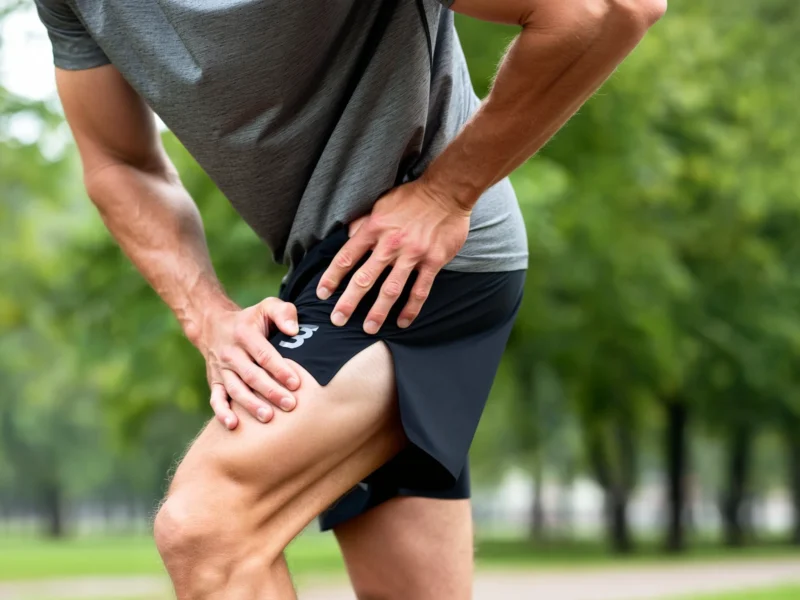
The typical symptom is deep pain in the groin, which the patient often indicates by cupping the hip with the thumb and index finger in a C shape. It worsens with prolonged sitting, getting in and out of a car, twisting and deep flexion. It is often accompanied by locking, clicking, a feeling that the hip “catches” and restriction of internal rotation. The pain may radiate to the buttock or the front of the thigh and may be confused with problems of the lumbar spine or with adductor tendinopathy.
Diagnosis
The clinical examination includes the impingement test (FADIR) and the FABER test. Plain radiographs show the morphology of impingement or dysplasia and exclude arthritis. MRI, ideally MR arthrography with intra-articular contrast, is the investigation of choice for imaging the tear. A diagnostic injection of local anaesthetic into the joint confirms that the hip is indeed the source of the pain.
Treatment
Conservative treatment is tried first: activity modification and avoidance of the positions that cause impingement, targeted physiotherapy for the hip abductors and rotators and the core, anti-inflammatories and, selectively, an intra-articular injection. When symptoms persist, hip arthroscopy allows the labrum to be repaired and, at the same time, the bony cause to be corrected with osteoplasty. Simple excision of the labrum without correction of the impingement gives inferior long-term results.
Why early diagnosis matters
Untreated impingement with a labral tear is now regarded as one of the main causes of early osteoarthritis of the hip. Timely repair can preserve the joint for decades. Book an appointment for an assessment.
Contact
Book an appointment with Dr. Tsarouhas
Fill in the form with the time that suits you and we will contact you, or call us directly.
Call us 210 6464 744-
Petroupoli 1 Agias Triados St., 132 31 210 5011 717
-
Heraklion, Crete 49 Kyrillou Loukareos St., 712 01
Appointment request
We reply to every request on the same or the next working day.
Your details are used solely to contact you.