
Orthopedic condition
De Quervain’s Tenosynovitis
De Quervain’s syndrome (or De Quervain’s tenosynovitis) is a painful inflammation of the tendons on the thumb side of the wrist. It causes pain when using the thumb and the wrist and is particularly common in new mothers and in people who perform repetitive movements of the thumb. It is a condition with a good prognosis.
Dr. Ioannis Tsarouhas, Orthopedic Surgeon with experience in conditions of the hand, treats De Quervain’s syndrome on an individualised basis, with the aim of relieving pain and restoring function.
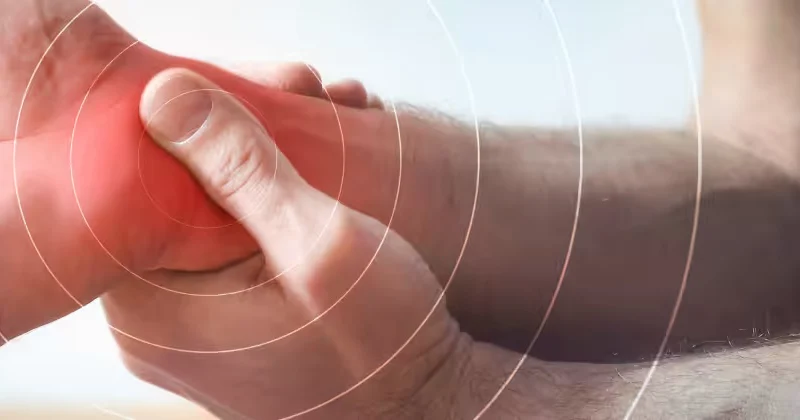
What is De Quervain’s syndrome?
Two tendons that move the thumb —the abductor and the short extensor— pass together through a common “tunnel” (sheath) on the thumb side of the wrist. In De Quervain’s syndrome, this sheath becomes inflamed and thickened, narrowing the space through which the tendons have to glide.
As a result, every movement of the thumb and wrist that requires these tendons to glide becomes painful. In other words, it is a condition of “overuse” or inflammation of the tendons, and not a problem of the joint itself.
Causes and risk factors
De Quervain’s syndrome is mainly associated with repetitive or prolonged movements of the thumb and wrist. Risk factors include:
- Repetitive movements that combine gripping with twisting of the wrist.
- Caring for an infant: It is particularly common in new mothers, because of the repetitive movement of lifting the baby with the thumbs held out to the side (which is why it is sometimes also called “mother’s wrist”).
- Female sex and middle age.
- Hormonal changes (pregnancy, the postnatal period).
- Inflammatory conditions, such as rheumatoid arthritis.
- Prolonged use of mobile devices and keyboards.
Clinical picture – Symptoms
The main symptoms are:
- Pain on the thumb side of the wrist, which may radiate towards the thumb or towards the forearm.
- Worsening with use of the thumb and wrist — especially in movements of gripping, wringing or lifting objects.
- Swelling in the area, sometimes with a “creaking” sensation on movement.
- Difficulty and weakness in gripping or pinching with the thumb.
The Finkelstein test is characteristic: when the patient closes the thumb inside the fist and bends the wrist downwards (towards the little-finger side), intense pain is provoked.
Diagnosis
The diagnosis is primarily clinical, based on the history, the location of the pain and a positive Finkelstein test. Special imaging tests are not usually required, although ultrasound may be used in selected cases to confirm the inflammation and rule out other conditions.
Treatment
The great majority of cases respond to conservative treatment.
Conservative treatment
- A thumb-and-wrist splint, which immobilises the thumb and the wrist, resting the inflamed tendons.
- Modification of activities and avoidance of the movements that cause pain.
- Anti-inflammatory medication and local application of ice.
- Local corticosteroid injection into the tendon sheath — a particularly effective method, which often offers significant relief.
- Physiotherapy, in selected cases.
Surgical treatment
In the rare, resistant cases that do not respond to conservative treatment, surgical treatment is indicated. The procedure —release of the narrowed sheath of the tendons— decompresses the area and allows the tendons to glide freely. It is a short procedure with very good results.
Prognosis
The prognosis of De Quervain’s syndrome is, as a rule, excellent. In cases related to temporary situations —such as the postnatal period— the symptoms often subside as the aggravating activity decreases or the hormonal balance is restored. With the right treatment, most patients obtain complete relief and return to their activities without lasting effects.
The role of activity modification
One of the most important —and often underestimated— elements in the treatment of De Quervain’s syndrome is the modification of the activities that cause it. Because the condition is, in essence, the result of overuse and repetitive strain of the tendons, no treatment will have a lasting effect if the aggravating activity continues unabated.
Identifying the “culprit” movements —and adapting them, where possible— is therefore fundamental. In combination with the splint, which rests the tendons, and the other conservative methods, activity modification allows the inflammation to subside and the tendons to heal. This approach also explains why the condition often subsides once the aggravating cause is no longer present.
Cost of treatment
The cost depends on the type of treatment (splint, injection or —more rarely— surgery) and the insurance cover. Precise information is given on an individual basis, after the clinical assessment. The practice is at your disposal for any relevant information.
More on the factors that determine the cost and on cover by insurance funds: Cost of surgery.
Prevention and ergonomics
Because De Quervain’s syndrome is closely related to repetitive movements of the thumb and wrist, prevention and the avoidance of recurrences focus on modifying these movements. Some practical measures include:
- Alternating hands and taking breaks during repetitive tasks.
- The correct lifting technique —for new mothers, lifting the baby with the palms instead of with the thumbs held out to the side.
- Ergonomic use of mobile devices, avoiding prolonged typing with the thumb.
- Strengthening and stretching of the muscles of the thumb and wrist.
These simple measures can reduce the strain on the tendons and help both in prevention and in avoiding the return of the condition after treatment.
Frequently asked questions
Why is De Quervain’s syndrome common in new mothers?
Because of the repetitive movement of lifting the baby with the thumbs held out to the side, which strains the tendons. It often subsides as the baby grows and this strain decreases. It is sometimes referred to as “mother’s wrist”.
Where exactly does it hurt?
On the thumb side of the wrist. The pain characteristically worsens when the patient closes the thumb in the fist and bends the wrist downwards (Finkelstein test).
Is surgery needed?
In the great majority of cases, no. A splint, modification of activities and injections are usually effective. Surgery is reserved for resistant cases.
Does a splint help?
Yes. The thumb-and-wrist splint rests the inflamed tendons and is a key part of conservative treatment, especially in combination with modification of activities.
Is the cost covered by insurance?
Cover depends on the type of treatment and the insurance policy. The practice can give you detailed information.
How quickly does it subside?
With the right conservative treatment, many patients obtain relief within a few weeks. In cases related to the postnatal period, the symptoms often subside as the aggravating activity decreases.
Does it come back after treatment?
It can recur, especially if the aggravating activity continues unabated. Modifying the movements and correct ergonomics are what reduce the risk of it returning after the initial relief.
Contact
Book an appointment with Dr. Tsarouhas
Fill in the form with the time that suits you and we will contact you, or call us directly.
Call us 210 6464 744-
Petroupoli 1 Agias Triados St., 132 31 210 5011 717
-
Heraklion, Crete 49 Kyrillou Loukareos St., 712 01
Appointment request
We reply to every request on the same or the next working day.
Your details are used solely to contact you.