
Revision joint replacement
Revision Hip Replacement
Revision hip replacement is the operation in which a previous artificial hip joint that has failed for some reason is replaced with a new one. It is a technically demanding, major operation that requires considerable experience and specialisation.
Dr. Ioannis Tsarouhas, with particular expertise in revisions of the major joints, also applies — where feasible — the modern ASI (Anterior Supine Intermuscular) method in revision surgery, with the aim of restoring the stability and function of the hip.
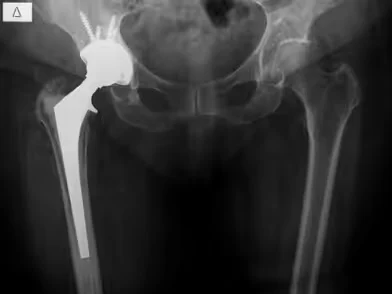
What is revision hip replacement?
Total hip replacement is one of the most successful operations in modern orthopedics, with excellent longevity. However, no artificial joint necessarily lasts forever. Over the years — or, more rarely, because of a complication — a hip replacement can fail and need to be replaced.
Revision is precisely that operation: the removal of the old, problematic implants and the insertion of new ones, specially designed for revision. As the number of patients with a hip replacement increases — and indeed at younger ages — revision operations are becoming ever more frequent.
When is revision needed?
The main causes of failure of a hip replacement that lead to revision are:
- Aseptic loosening: The progressive loss of the stable fixation of the implants to the bone, often due to wear of the liner and osteolysis — the most common cause.
- Infection: One of the most serious causes, which requires specialised treatment.
- Dislocation / instability: Recurrent dislocation of the prosthetic joint.
- Wear of the bearing surfaces (of the liner and the head).
- Periprosthetic fracture: A fracture of the bone around the prosthesis.
- Osteolysis: Loss of bone around the implants.
Accurate identification of the cause of failure is the first and most critical step, as it determines the revision strategy.
Diagnosis and pre-operative assessment
Before any decision on revision, a detailed investigation of the cause of failure is required. The assessment includes clinical examination and history, radiographs (often serial, in order to show the progression of loosening or osteolysis), blood tests for inflammatory markers and — when infection is suspected — joint aspiration with culture of the synovial fluid. In selected cases, advanced imaging is used to assess the bone stock.
Particularly critical is the distinction between aseptic and septic failure, as the treatment differs radically.
How revision is performed
The revision operation is technically far more demanding than the original replacement. The surgeon works in an anatomy that has already been altered, with scar tissue and, often, bone defects.
In general terms, revision involves the careful removal of the old implants — preserving as much healthy bone as possible — thorough debridement, reconstruction of the bone defects (with bone graft or special metal augments), and the insertion of special revision prostheses, which are often anchored deeper and more securely in the bone. The ASI method can also be used here, where feasible, offering the advantages of muscle preservation.
The special case of infection
When the cause of failure is infection, treatment is, as a rule, carried out in two stages: removal of the implants and insertion of a temporary antibiotic-loaded spacer, a period of intensive antibiotic treatment, and at a second stage — once the infection has been eradicated — insertion of the definitive prosthesis, in collaboration with an Infectious Diseases specialist.
The difference from primary replacement
Many patients wonder why revision is considered so much more demanding than the original replacement. The answer lies in the conditions under which the surgeon works. In a primary replacement, the anatomical ground is “virgin”, with normal anatomy and healthy bone.
In revision, by contrast, the surgeon must first remove the existing implants — often well fixed — without destroying healthy bone, deal with the scar tissue from the previous operation, and address the bone defects that have already developed. In addition, stability must be restored in an environment where the normal stabilisers may have been weakened. This complexity makes the experience and specialisation of the surgeon decisive.
Why revisions are increasing
The number of revision operations is increasing internationally, and this does not mean that joint replacements are failing more often — on the contrary, modern implants are more durable than ever. The reason is twofold: on the one hand, far more primary replacements are now performed, so the absolute number of those that will need revision also increases; on the other hand, replacements are being performed in younger, more active patients, who place demands on the prosthesis for more years.
The good news is that, in parallel, the treatment options have also evolved dramatically, so that revision can today offer excellent results, even in complex cases.
Realistic expectations
An important part of preparing for a revision is being properly informed and forming realistic expectations. In the great majority of cases, revision offers substantial pain relief and a significant improvement in function. It is, however, a more complex operation, with a longer recovery. Honest information about all of this, combined with the experience of the surgeon, ensures the patient’s satisfaction with the final result.
Post-operative course and rehabilitation
Recovery after revision hip replacement is, as a rule, longer and more cautious than after the primary operation. The pace depends on the extent of the surgery, the quality of the bone and the possible need to protect bone grafts. Mobilisation begins with walking aids and protected weight-bearing, according to the surgeon’s instructions, while the physiotherapy programme focuses on restoring movement, muscle strengthening and gait retraining.
What results should I expect?
Revision hip replacement offers the great majority of patients significant pain relief and a substantial improvement in function. It is, however, important for expectations to be realistic: the result of a revision, although as a rule very good, depends on the cause of failure, the quality of the remaining bone and the condition of the soft tissues. The specialisation and experience of the surgeon are decisive here.
Cost of revision hip replacement
The cost of revision varies more widely than that of the primary operation, as it depends on the cause and the extent of the surgery, the specialised implants and materials, the possible need for two-stage treatment in the case of infection, the hospital and the length of stay, as well as the patient’s insurance cover. In most cases, private insurance policies and insurance funds cover a significant part of the expense.
Precise information is given on an individual basis, after the diagnostic assessment. The practice is at your disposal for any relevant information.
More on the factors that determine the cost and on cover by insurance funds: Cost of surgery.
The role of the specialised centre
Revision hip replacement is among the most demanding operations in orthopedics. It requires not only experience, but also special equipment, access to the full range of specialised revision implants, and the capacity for multidisciplinary collaboration — with infectious diseases specialists, anaesthetists and other specialties — particularly in complex cases with infection or large bone defects.
For this reason, revision operations are, as a rule, performed by surgeons with specific experience, in an appropriately organised setting. Choosing the right surgeon and centre is not simply a preference, but a decisive factor in the outcome of the operation.
The role of rehabilitation
Recovery after revision hip replacement is, as a rule, longer and more cautious than after the primary operation. Mobilisation begins with walking aids and protected weight-bearing, according to the surgeon’s instructions, particularly when bone grafts that need protection have been used.
Patience and consistency are particularly important here for an excellent final result.
Frequently asked questions
Why might a hip replacement need revision?
The most common causes are aseptic loosening, infection, dislocation/instability, wear of the bearing surfaces, osteolysis and periprosthetic fractures.
Is it more difficult than the original replacement?
Yes. Revision is technically more demanding, as it involves removing the old implants, managing bone defects and using specialised prostheses. It should be performed by a surgeon with specific experience.
Can the ASI method be used in revision?
Yes, in selected cases the ASI method can also be used in revision, offering the advantages of muscle preservation. Suitability is assessed on an individual basis.
What happens if there is an infection?
In the case of infection, treatment is, as a rule, carried out in two stages: removal of the implants and insertion of a temporary antibiotic-loaded spacer, and at a second stage — once the infection has been eradicated — insertion of the definitive prosthesis.
How long does recovery take?
It is, as a rule, longer than after a primary replacement and depends on the extent of the surgery, the quality of the bone and adherence to the physiotherapy programme.
Is the cost covered by insurance?
In most cases, private insurance policies and insurance funds cover part or all of the expense. The practice can inform you in detail.
How many times can a joint replacement be revised?
There is no absolute limit; as many revisions as are required can be performed. The limit is usually set by excessive loss of bone mass, persistent infection or the patient’s general state of health.
Contact
Book an appointment with Dr. Tsarouhas
Fill in the form with the time that suits you and we will contact you, or call us directly.
Call us 210 6464 744-
Petroupoli 1 Agias Triados St., 132 31 210 5011 717
-
Heraklion, Crete 49 Kyrillou Loukareos St., 712 01
Appointment request
We reply to every request on the same or the next working day.
Your details are used solely to contact you.