
Orthopedic condition
Achilles Tendon Rupture
The Achilles tendon is the strongest tendon in the body and transmits the force of the gastrocnemius and soleus muscles to the heel. Its rupture is one of the most common injuries in adults aged 30 to 50 who play sport occasionally, and correct management in the first few days determines the final outcome.
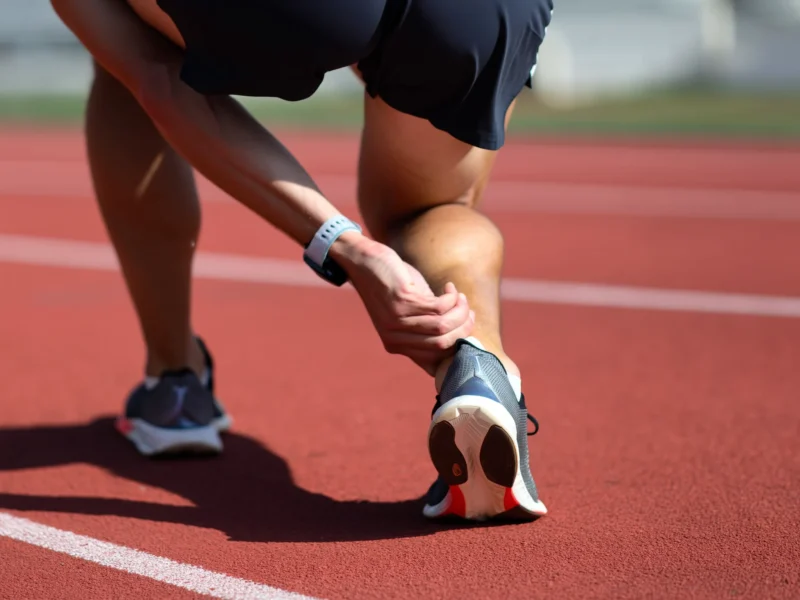
How it happens
The rupture usually occurs during a sudden, explosive movement: pushing off to run, jumping, or changing direction in tennis, football or basketball. The tendon typically tears 2 to 6 centimetres above its insertion on the heel, in the so-called “critical zone” with the poorest blood supply. Predisposing factors are pre-existing tendinopathy, corticosteroid injections in the area, the use of quinolones, a sudden increase in training after a period of inactivity, and age.
Symptoms
The patient characteristically describes a sudden, strong blow or kick to the back of the calf, often with an audible snap. This is followed by severe pain, inability to stand on tiptoe and a weak, limping gait. A gap can usually be felt along the course of the tendon, while swelling and bruising soon appear. Because the other flexors can weakly flex the foot, the injury is missed at the first examination in a significant proportion of cases.
Diagnosis
The diagnosis is primarily clinical. The Thompson test is the most reliable: with the patient lying prone, squeezing the calf does not produce plantar flexion when the tendon is ruptured. Ultrasound confirms the rupture, measures the gap and is a dynamic examination. MRI is used in doubtful, partial or neglected ruptures and in the planning of surgery.
Treatment
Conservative. With modern functional treatment protocols – a brace with adjustable wedges holding the foot in equinus, which is gradually reduced, with early controlled weight-bearing and mobilisation – the results approach those of surgery, with zero risk of infection. The prerequisites are apposition of the tendon ends on ultrasound and good patient compliance. The re-rupture rate remains somewhat higher.
Surgical. Suturing of the tendon, either open or with a percutaneous small-incision technique, restores the length and tension of the tendon with greater precision, reduces the risk of re-rupture and is preferred in young patients, athletes, ruptures with a large gap and neglected or recurrent ruptures. The risks mainly concern the wound and the sural nerve.
Rehabilitation
With both options, rehabilitation is gradual and lasts months. The first two weeks are devoted to protection and swelling, followed by progressive weight-bearing and reduction of the equinus position up to the sixth to eighth week, strengthening exercises from the third month, light running at four to five months and return to sports involving jumping and changes of direction at six to nine months. Recovery of the strength of the gastrocnemius, and not time, is the criterion for return.
Contact
Book an appointment with Dr. Tsarouhas
Fill in the form with the time that suits you and we will contact you, or call us directly.
Call us 210 6464 744-
Petroupoli 1 Agias Triados St., 132 31 210 5011 717
-
Heraklion, Crete 49 Kyrillou Loukareos St., 712 01
Appointment request
We reply to every request on the same or the next working day.
Your details are used solely to contact you.